Powerless
Every morning, from the comfort of a rented apartment in New York, I check the weather forecast for Lytton. Today there is a snowfall warning. Blistering cold. Ice causes accidents, accidents close roads. I read the worried Facebook posts, I feel the community’s tension as winter suddenly sets in.
The first winter after the fire was the hardest one in decades. I don’t mean because of the trauma and the isolation and the raw ruins of our town, although there was that too. It was a winter of the heaviest rainfall, the strongest winds, the deepest snowfall, the coldest temperatures. Every change in weather felt record-breaking, a new level of awful.
The fire had changed everything: a raging beast, out of control. And in that winter, even when the fire was out — the beast was gone — we were still helpless. Again and again, nature reminded us that we were unsafe. We cowered in the onslaught of disasters.
We were tiny, fragile specks trying to survive in an enormous, dangerous world.
I think back to that time, when everything seemed hostile, so far beyond my control. Weather, disaster, bureaucracy, insurance, society, illness. I looked around me, eyes wide, powerless.
There must have been a brief reprieve as winter faded, before the fear of another fire season set in. A little moment of awe, a little glimmer of beauty.
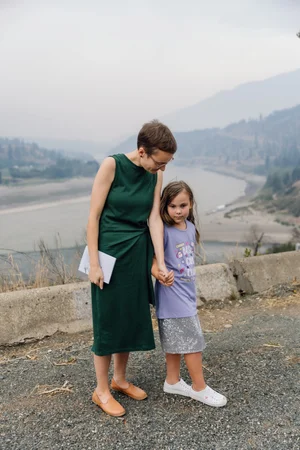
In the spring, a friend came to visit us. She played with Helen, she cooked meals, she sat in the softly lit living room with her snuggly dog and coffee and love. Together, we went to the ruins of Klowa — a place I had only been able to visit once — and it was there, finally, with that good friend, that I stepped away from helplessness and into something active, productive, strong.
I stepped into anger.
Two
The second time
I visited my ruins
was in the spring
nine months after the fire
the dangerous walls
still standing
the loose bricks
more
settled
the ash and debris
the same
a friend climbed into the basement
pit of ashes
with a hand rake
sifted for hours
uncovering relics
of my past
broken sculpture
fractured china
rusted jewellery
embedded in pieces of shattered glass
I sat at the top
watched what she pulled out
feeling nothing
except a dull curiosity
how a burned doorknob looks like a vase
or knitting needles crumble with touch
or only the ugliest dishes survive
feeling dull curiosity
but no attachment
to this excavation
of life
she brought up jars
herb-infused salts
products I made in the kitchen
a few days before the fire
the glass still intact
just scorched
she set them gently
on the sidewalk
beside me
and one by one
I smashed them
I read this poem during an interview that aired recently on NPR and CBC Radio. If you’d like to hear it in my own voice, you can listen to the audio here:
(Our discussion about the poem starts at 11:26 and “Two” itself begins at 13:57.)

“Two” excerpted from my book
Burning Sage: Poems from the Lytton fire
by Meghan Fandrich
Publisher: Caitlin Press
Cover design: Benjamin Salesse
Paperback, 88 pages